|
Home
School Logo
Credo & Mission Statement
History
Campus
Facilities
Extra-Curricular
Activities
Administration
Faculty
School Calendar
Alumni
Newsletter
Photo Album
Staff
Student Web Pages
Montessori Links
|
Curriculum |
|
|
PRINCIPLES OF
THE MONTESSORI METHOD
Regina
Maria Montessori follows the Montessori Curriculum in the CASA
(Pre-School Department) and the Department of Education, Culture and
Sports (DECS ) curriculum in the Elementary Department.
RESPECT FOR THE CHILD
Because each child is
unique, education for each child should be individualized.
THE
ABSORBENT MIND
The child's absorbent mind has conscious and unconscious stages
of development.
SENSITIVE
PERIODS
All children pass through sensitive periods. Adults should provide optimum learning experiences during these specific periods.
THE PREPARED
ENVIRONMENT
The
purpose of the prepared environment is to make the child
independent of the adult. The school is a place where the
child can do things for himself.
SELF OR
AUTO-EDUCATION
The child
learns or discovers by himself through the use of Montessori
didactic materials.
THE MONTESSORI METHOD IN
PRACTICE
|
|

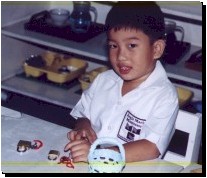
OPENING LOCKS WITH KEYS |
PRACTICAL LIFE
EXERCISES/MOTOR
EDUCATION
The exercises of practical
life are designed to teach the child to function in his own
environment by teaching him to cope with the things around him.
The prepared environment emphasizes basic everyday motor
activities such as walking on a line, and being silent.
Practical life activities build on the child's natural interest
and help him develop good work habits, concentration, eye-hand
coordination, a lengthened attention span and control of his
body.
|
|
SENSORIAL MATERIALS &
EXERCISES
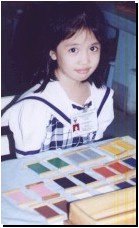
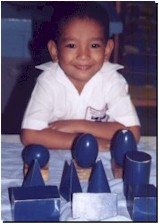
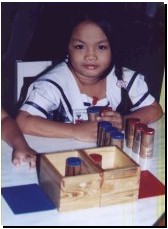
Sensorial
exercises are concerned with the development and refinement of
the six senses (sense of touch, sight, muscular memory, sound,
smell, and taste) which are sharpened through the use of
various materials ingeniously designed for specific purposes.
The sensorial materials are often labeled didactic (designed to
instruct).
|

Chime
|
LANGUAGE
(WRITING AND READING)
The
development of language runs parallel to all activities in the
Montessori classroom. Language is learned naturally without
conscious effort. Objects in the environment are specifically
identified or categorized. Acquisition of spoken language skill
is through conversation, games, poems and stories. Writing
precedes reading. The child develops each vital muscle for
writing through specialized instruments, learns to sound
off each letter and eventually learns to analyze each sound for
reading and composing (spelling) words.
|

METAL INSET |

|
|
SAND
PAPER LETTERS |
MATHEMATICS
|
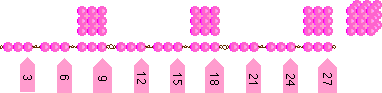
Mathematical
concepts are presented in the most concrete manner. Beginning
with number concepts I to 9, the child is exposed to different
hierarchies of numbers presented sequentially from quantities to
symbols. The four operations (addition, subtraction,
multiplication and division) and the decimal system are
introduced in the pre-school level.

10
Beads Chain
|
|
|

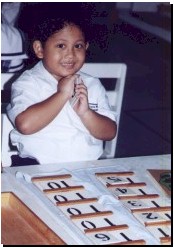
Seguin
teen Board
|
|
|
|
|
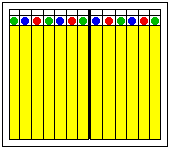
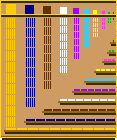
Decimal Fractions
|
|
 Beads Five
|
|

Red Blue Rod
|

|
100
Beads Square |
 |

Globes |
| GEOGRAPHY |
|
|
CULTURAL ARTS
The world is presented to
the child through cosmic education. Zoology, Botany, Geography
and History are woven in the study of man's interdependence with
nature. Art and Music gain importance as fullest expressions of
thoughts and feelings. |
|
|
|
|
|
|